I booked a Mozart concert at Schönbrunn Palace on my very first night in Vienna.
It felt bold. Slightly indulgent. I had barely unpacked my suitcase, and here I was sitting in an 18th-century Orangery listening to live Mozart. Not a bad way to begin a trip.
I may earn a small commission if you make a purchase using my affiliate links.
I’m Hazel, a British solo traveller and writer, and I attended this Mozart concert alone on my first night in Vienna. Cultural experiences can feel intimidating solo, so I wanted to see what it was really like.
The concert took place in the Orangery at Schönbrunn Palace, where Mozart himself performed in 1786. At the time, I did not know what an orangery actually was. I assumed it involved oranges. Technically, that is true. Historically, they were grand glass structures built to protect citrus trees during winter. This one now protects violins instead.
It was formal, but not intimidating. Elegant, but not stiff. And by the end of the night, I was completely, unexpectedly converted.
The Setting and Atmosphere
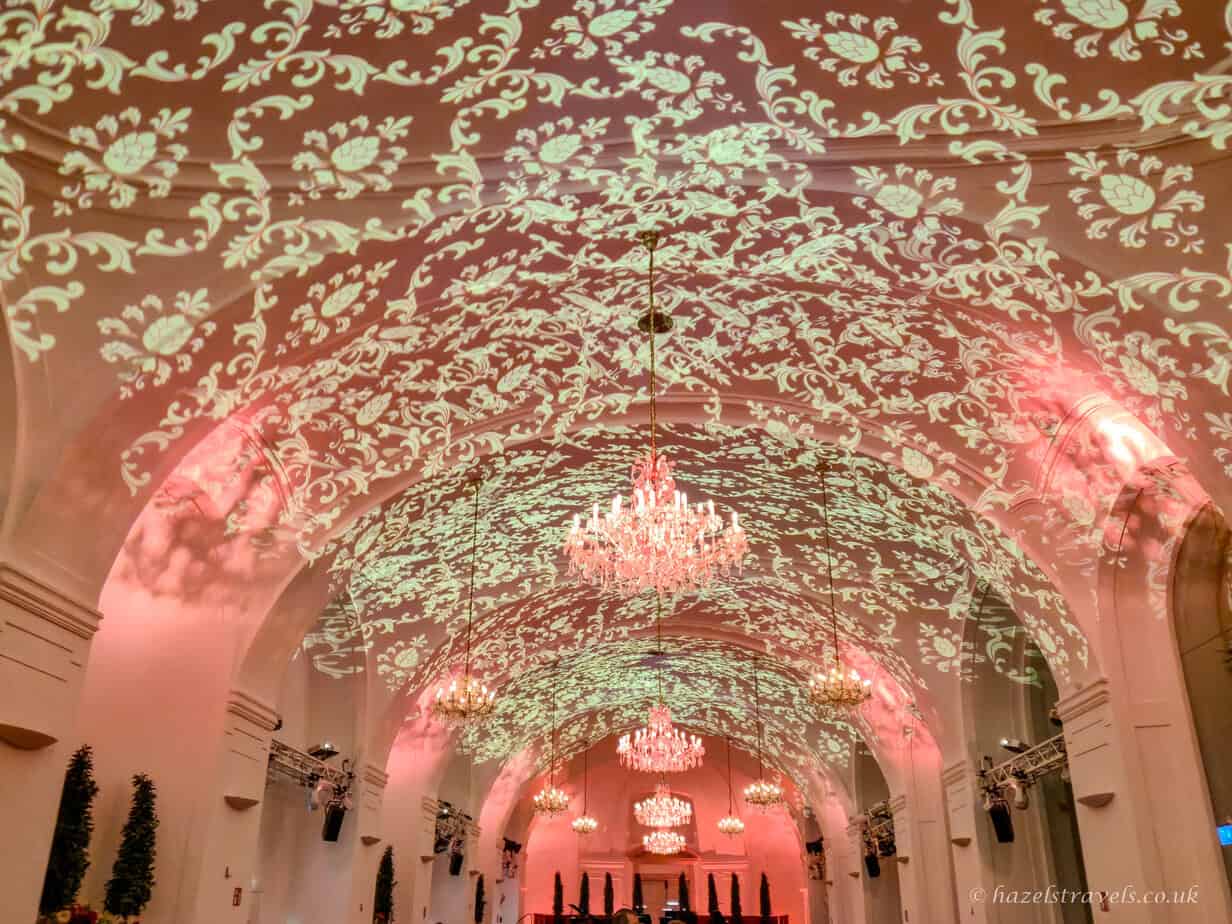
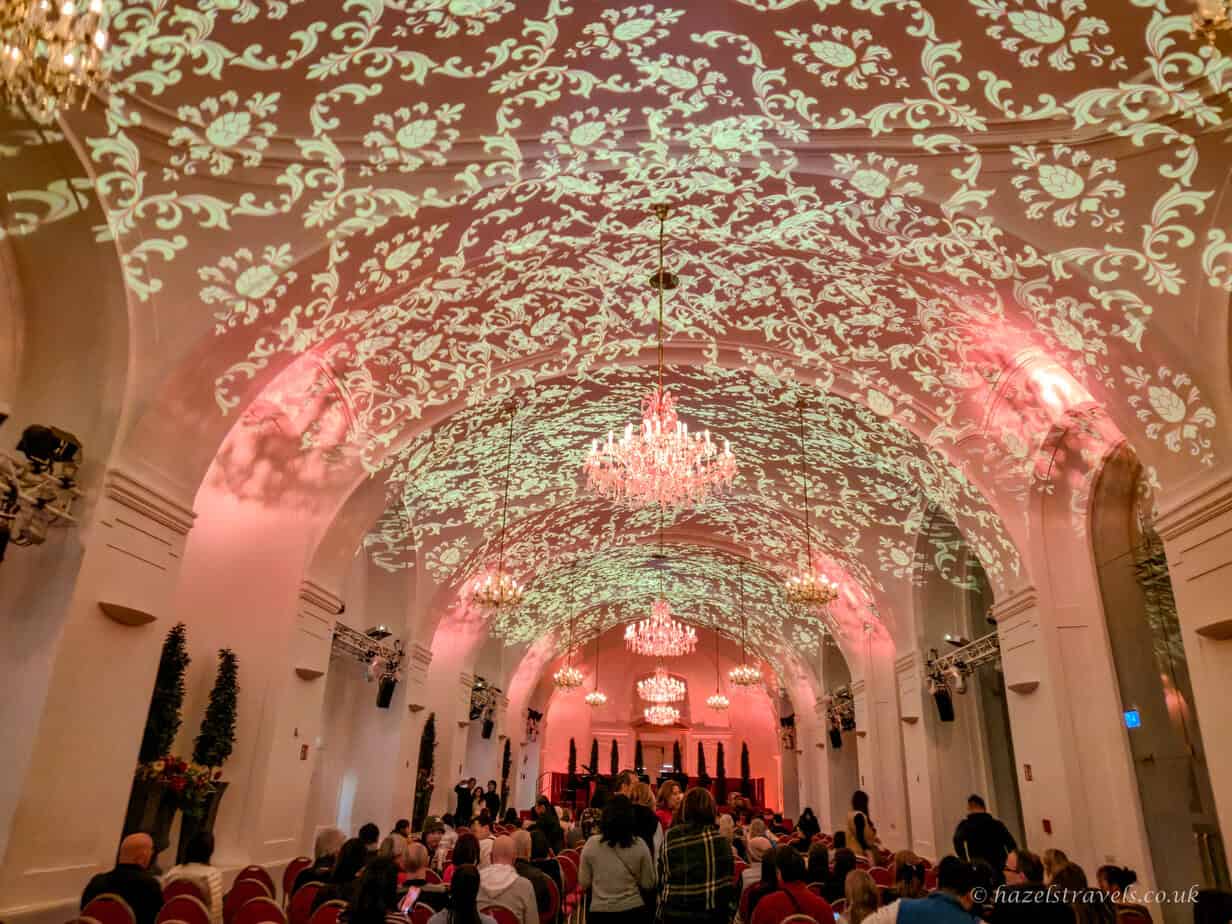
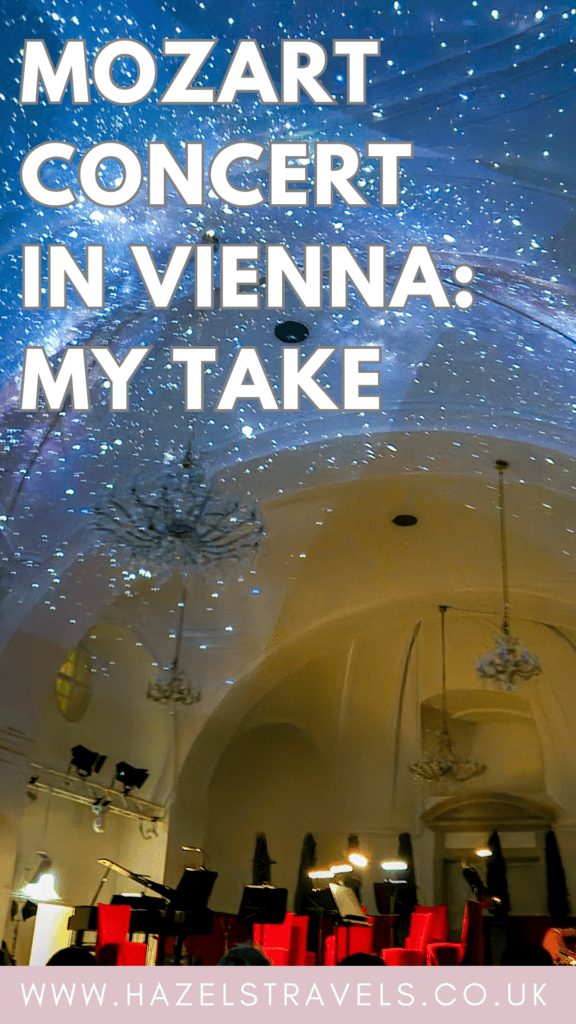
The Orangery is a vaulted, arched space rather than a traditional theatre. Rows of red upholstered chairs are arranged in two banks facing a modest stage, with a central aisle between them. The first few rows are labelled VIP, although the seats are identical.
VIP guests receive a programme and a drink with their ticket, which feels like a very Viennese way of elevating the experience. The ticket I booked was seated just behind the VIPs, a few rows back (see photo below).
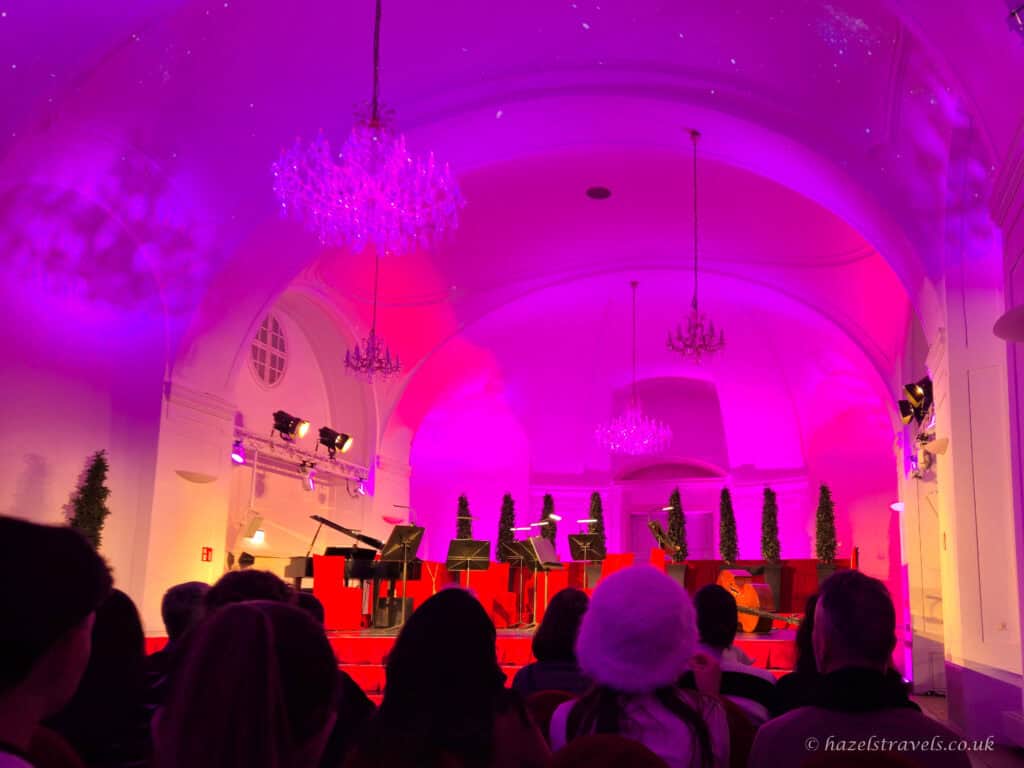
The orchestra wore black tie. Some of the audience had made an effort too, while others were more casual. It felt far less daunting than the Vienna Opera House. You do not need to understand the difference between a symphony and a sonata to belong there.
There is a bar in an adjoining room. It is not dripping in chandeliers, but it is perfectly respectable. During the interval, people gather, take photographs, and chat.
What surprised me most, even before the first note, was the ceiling.
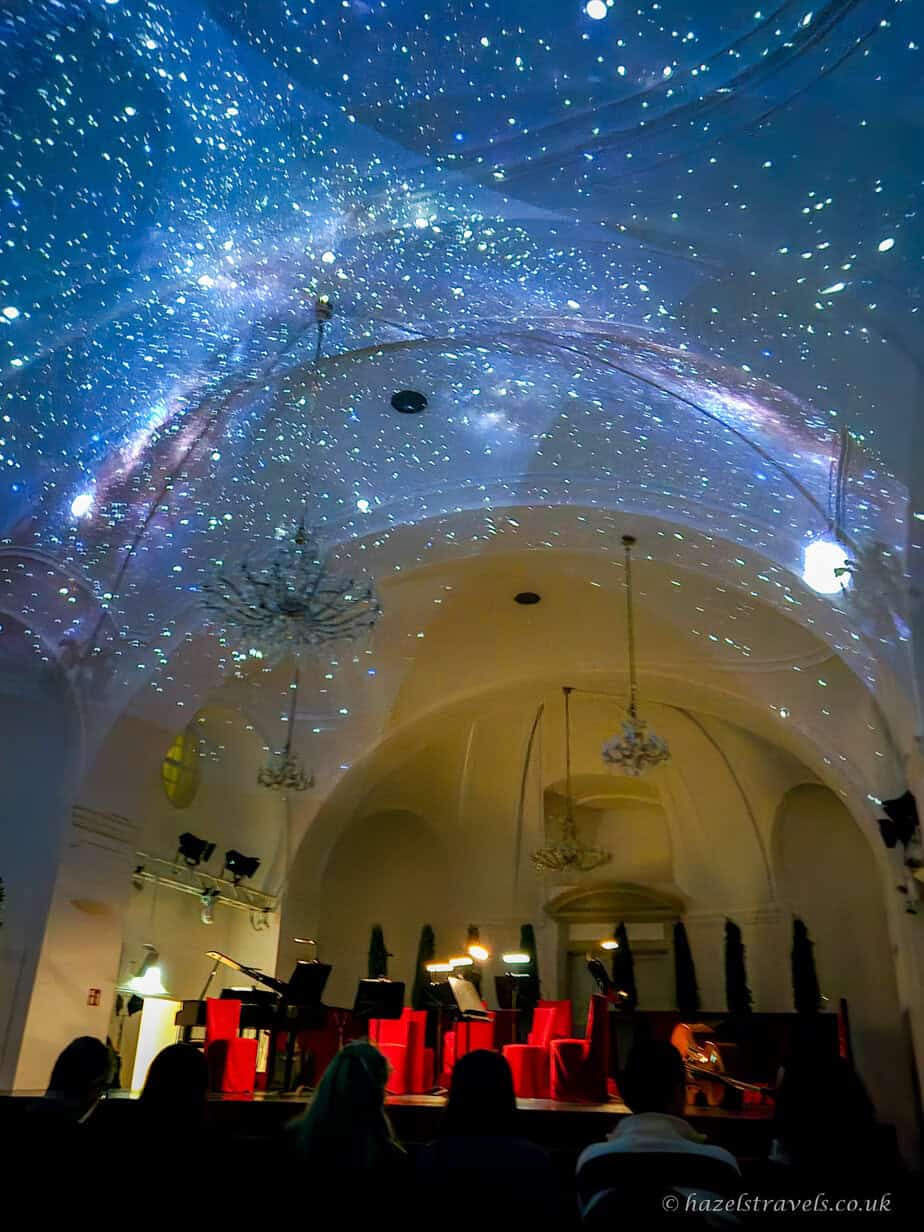
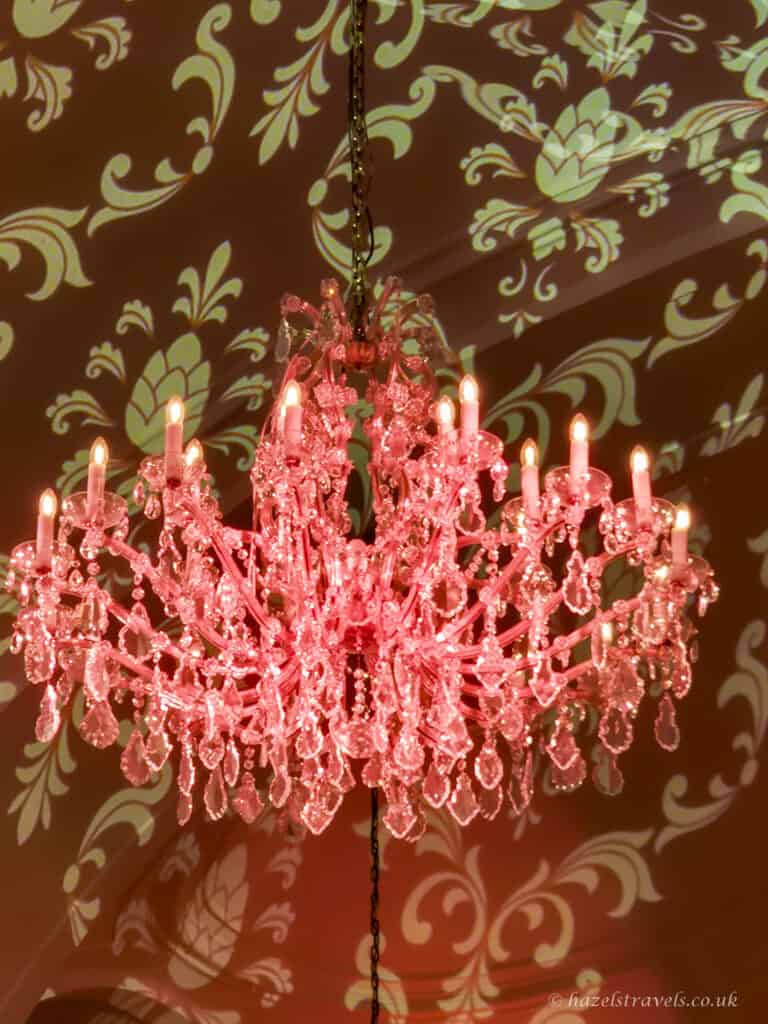
Moving light projections drifted across the curved vault above, with intricate patterns sliding softly over the arches. On a flat ceiling, it might have looked decorative. On this arched vault, it felt immersive. It quietly transformed the room into something magical.
The Orchestra and the First Violin
The ensemble performing that evening was the Schönbrunn Palace Orchestra, a Viennese chamber orchestra that plays regularly at the Orangery and internationally.
They emphasise the Viennese interpretation of the music they play. I could not have defined that beforehand, but I suspect I felt it. There was warmth and lift in the phrasing, something that felt expressive rather than clinical.
What fascinated me most was the absence of a conductor. Instead, everything was led from within the orchestra itself. It turns out this is normal for a chamber orchestra of this size – but I still found it unexpectedly compelling.
Tanja Sallustio, the concertmaster and principal first violinist, remained seated in the usual first violin position. From there, she guided tempo and entries with subtle movements of her bow, her posture, even the smallest tilt of her head. Musicians seated behind and beside her followed every cue effortlessly.
It was quietly astonishing.
I found myself glancing at her throughout the performance, not because she was showy, but because the coordination was so fluid. The ensemble breathed together, shifted pace together, softened and swelled together. There was no visible hierarchy, only a sense of shared responsibility.
It made the music feel as though it was unfolding between them rather than being directed at them.
The flute solo during The Magic Flute was exquisite. The cellist drew out passages that felt almost physical in their depth. In truth, they were all exceptional.
The Music and the Singers
The programme featured works by Mozart and Strauss.
Some pieces were purely orchestral. Others included two opera singers, soprano Simona Eisinger and baritone Michael Havlicek. They entered from different parts of the room, sometimes even from behind the audience, which gave the evening a theatrical edge without turning it into a full opera.
Their voices were extraordinary. Hearing trained opera singers at close range is humbling. It becomes very clear that most of us, however enthusiastically we sing in kitchens or cars, are not operating in the same universe.
They performed solos and duets, some serious, some playful. The humour surprised me.
There were moments when the orchestra and singers engaged in light theatrical jokes. At one point, the pianist dramatically pleaded for something to play during a piece in which he had no part. The orchestra leaned into the joke. The audience laughed. It never felt gimmicky. The playfulness added warmth without diminishing the music.
And then came Turkish March.
I did not expect to be so moved by it. It was lively and triumphant and somehow stirring.
I recorded myself humming it into my phone afterwards so I would not forget it. Thankfully, no professional opera singers were within earshot. I then spent far too long watching performances of it on YouTube back at my hotel.
That was the moment I realised something.
I really liked Mozart – at least in this Viennese style.
The Interval (Solo Perspective)
Intervals are often the most awkward part of attending anything alone.
Here, it felt manageable. No one was watching me be alone.
People drifted into the bar area, ordered drinks, took photographs and browsed the small art and jewellery display set up by a local artist. I bought the programme during the break for 10 EUR, mostly because by that point I wanted to know exactly what I had just listened to.
I am glad I did. It now sits tucked into a notebook at home, a reminder of my first evening in Vienna and the unexpected discovery that I genuinely enjoy Mozart when it is played like this.
The Ending
When the concert ended, the audience rose to their feet. There was cheering, whooping, and sustained applause.
It surprised me slightly. I had imagined restrained, polite clapping. Instead, there was real enthusiasm. Vienna appreciates good music, and these musicians were exceptional. The standing ovation felt deserved.
So, Is the Schönbrunn Mozart Concert Worth It?
If you are looking for an ultra-exclusive, gilded opera house experience, this is not that.
If you are looking for a well-executed, atmospheric, high-quality classical concert in an elegant setting that feels accessible and welcoming, then yes. Absolutely.
It is formal enough to feel special. Relaxed enough to attend alone. Structured enough to impress. Light-hearted enough to delight.
For me, it was one of the highlights of my Vienna trip, and an unforgettable way to begin it.
Practical Details: Finding the Concert and What to Know
The concert takes place in the Orangery complex, not inside the main palace building. It is run by a separate concert company.
If you are planning to attend, here are a few things worth knowing:
- The entrance to the Orangery is located along the left-hand side of the palace exterior, towards the metro station. Look for blue banners marking the concert venue. I have pinned the exact location of the entrance door on the map below.
- The main palace ticket office cannot assist with concert tickets. If you need to book tickets or collect tickets in advance, make sure you go directly to the Orangery entrance.
- Several people appeared unsure about where to go, so allow a little extra time (and see my map below!)
- A mandatory cloakroom costs 5 EUR. All coats must be left there. This can create a small queue at the end of the evening.
- Photography during the performance is strictly prohibited.
FAQs About the Mozart Concert at Schönbrunn 💡
Thinking of booking a Mozart concert at Schönbrunn? Here are a few quick answers, especially if you are considering going solo.
Is the Mozart concert at Schönbrunn worth it?
If you want an elegant but accessible classical music experience, yes. It is not a grand opera house spectacle, but the musicianship is excellent, the setting is atmospheric, and it feels special without being intimidating. For me, it was one of the highlights of my Vienna trip.
Is the concert suitable for solo travellers?
Very much so. I attended alone and never felt out of place. The atmosphere is relaxed, the interval is easy to navigate solo, and you are there to listen rather than socialise. It is a lovely way to spend an evening on your own.
What should you wear to the Schönbrunn Mozart concert?
Smart casual works perfectly. Some guests dress up, others keep it simple. You do not need evening gowns or tuxedos, just something that feels a little polished. And remember, there is a mandatory cloakroom, so you will be parting with your coat.
Related Reading
If you’re planning more cultural experiences in Vienna, you might also enjoy:
• Vienna State Opera: What It’s Really Like (Especially If You’re Going Solo) – a different, more upscale experience, with tips and advice for attending the Opera House.
• Things to Do at Schönbrunn Palace: What to See and How to Plan Your Visit – a practical guide to the palace, gardens, zoo and Palm House
• Visiting Schönbrunn Palace in Winter: Is It Worth It? – what it’s really like in snow and minus six degrees
• Inside the Schönbrunn Palace: Is the After Hours tour Worth It? – Photos from inside the palace, and whether the tour is worth it.
If you’re visiting Schönbrunn during the day, combining it with an evening concert makes for a very full, very Viennese experience.
Pin This Mozart Concert Guide 📌
Thinking about attending a Mozart concert at Schönbrunn Palace? Save this honest guide to what it’s really like – from the atmosphere and music to the practical details.
👉 Looking for practical travel tools? Check out my Travel Resources page.
Tags: Austria, Schönbrunn, Vienna
Leave a Reply